
Crypto Sports Betting Odds Explained: How Payouts Work
April 27, 2026
Crypto sportsbook betting has plenty of advantages over traditional sports betting due to its use of blockchain technology. However, it still carries the same risks that come with standard sports betting for players who do not fully understand how to read sports betting odds. Faster withdrawals and global accessibility do not eliminate the need to understand how pricing works.
Understanding odds is essential for profitable sports betting because they determine both risk and reward. Odds show how likely an outcome is considered to be, while also defining the exact payout if the bet wins. Without understanding this relationship, bettors may place wagers that look attractive but offer poor long-term value.
Odds reflect both implied probability and potential payout. For example, in a tennis match between Novak Djokovic and Jannik Sinner, if Djokovic is priced at 1.50 and Sinner at 2.80, the market suggests Djokovic is more likely to win. However, a successful bet on Sinner would generate a much larger return because of the higher risk.
This article explains how betting odds work, breaks down the main formats used in crypto sportsbooks, and teaches clear payout calculations. By understanding these fundamentals, bettors can make more informed and disciplined decisions.
What Are Betting Odds?
Betting odds reflect the probability and the potential return of a bet. They show how likely a sportsbook believes a particular outcome is and determine how much a bettor can win relative to their stake. Every market, whether it is a match winner or a totals bet, is priced using odds.
There is a direct relationship between probability and payout. Higher odds indicate lower implied probability but offer greater potential returns if the bet wins. Conversely, lower odds suggest a higher chance of success but deliver smaller profits, which is why favorites pay less than underdogs.
Crypto casinos that offer sports betting set odds not only to reflect probability but also to balance action on both sides of a market. By adjusting prices based on betting patterns and new information, they aim to reduce risk exposure. This built-in adjustment also ensures the sportsbook maintains a margin over time.
The Three Main Odds Formats
There are three main formats that players need to learn before placing a bet, as it is impossible to understand how to read sports betting odds without having this basic knowledge. While the numbers may look different across platforms, they all represent the same underlying concepts of probability and payout. The key is knowing how to interpret each format correctly.
Decimal odds are the most common format in crypto betting. They are displayed as numbers such as 2.50, 1.80, or 3.00 and show the total return for every unit staked. The payout is calculated using a simple formula: Stake × Odds.
For example, in a football match between Arsenal FC and Real Madrid CF, a $20 bet at 2.50 odds would return $50 in total. The profit is calculated by subtracting the original stake, meaning $50 − $20 = $30 profit.
American odds, also known as moneyline odds, are displayed as figures such as -110 or +150. Negative odds show how much must be wagered to win $100, while positive odds show how much profit is earned from a $100 stake.
For example, in an NBA game between the Los Angeles Lakers and the Boston Celtics, +150 means a $100 bet wins $150 profit, while -110 requires a $110 stake to win $100.
Fractional odds are common in the UK and appear as 3/2 or 5/1. They represent profit relative to stake, meaning 3/2 returns $3 profit for every $2 wagered. In a snooker match between Zhao Xintong and Mark Allen, 5/1 odds mean a $10 stake would generate $50 profit if successful.
Most crypto sportsbooks allow the user to change the odds format based on their preference, so it is important to understand how at least one of these systems works.

Converting Between Odds Formats
Understanding how to convert between odds formats helps bettors compare prices across different sportsbooks. Since crypto betting platforms often default to decimal odds, knowing how to switch between decimal, American, and fractional formats ensures accurate evaluation of value.
To convert decimal odds to American odds, two formulas are used. If the decimal is above 2.00, subtract 1 and multiply by 100. If the decimal is below 2.00, divide -100 by (decimal − 1). For example, decimal odds of 2.50 convert to +150 in American format.
Converting a decimal to a fraction is straightforward. Subtract 1 from the decimal and express the result as a fraction. For instance, 2.50 decimal becomes 1.50 fractional, which simplifies to 3/2.
To convert American odds to decimal, use these formulas: if the American odds are positive, divide by 100 and add 1. If negative, divide 100 by the absolute value and add 1.
Calculating Payouts: Step-by-Step Examples
Understanding payout calculations is essential for evaluating whether a bet offers good value. Below are clear examples using real sports scenarios and decimal odds, which are most common on crypto sportsbooks.
Example 1: Football Moneyline Bet
In a match between Manchester City FC and Paris Saint-Germain FC, a bettor places $50 on Manchester City at 1.80 odds. The total payout is calculated as $50 × 1.80 = $90. Profit is $90 − $50 = $40.
Example 2: Tennis Match Bet
A bettor places $30 on Carlos Alcaraz to beat Daniil Medvedev at 2.20 odds. The payout is $30 × 2.20 = $66. Profit equals $66 − $30 = $36.
Example 3: Accumulator Bet
Betting $20 on Juventus FC at 2.00 and FC Barcelona at 1.50 creates combined odds of 3.00. The payout is $20 × 3.00 = $60, producing $40 profit if both selections win.
Odds Movement and Line Shopping
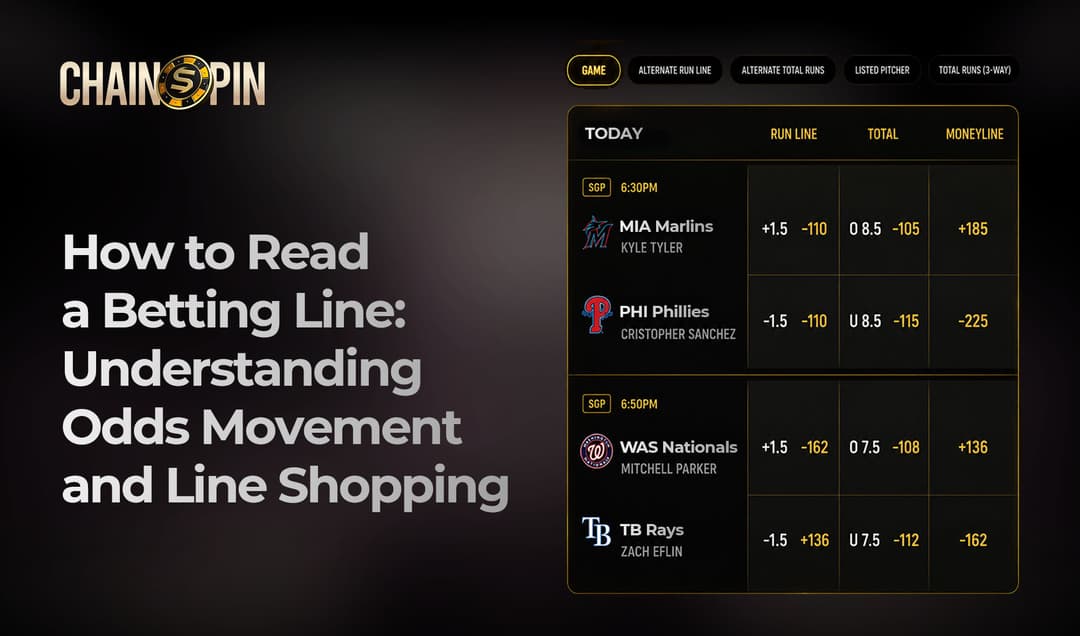
Odds change constantly. Platforms and algorithms base odds on hundreds of variables, which means there are constant shifts in probability. That is why it is important to keep an eye on them and be prepared to make adjustments to betting plans.
Odds move over time because sportsbooks react to betting volume, injuries, team news, and market sentiment. If large amounts of money are placed on one side of a market, the sportsbook may shorten those odds to reduce exposure. New information, such as a key player injury or weather update, can also cause rapid price adjustments.
There is often a difference between early odds and game-time pricing. Early lines may offer value before the wider public reacts, while late movement reflects a sharper market consensus. Monitoring these changes allows bettors to identify better entry points and potentially secure stronger payouts.
Tips for Maximizing Payouts
While there’s no way to guarantee success when it comes to sports betting, if you understand how to read sports betting odds and implement some of the following tips, your chances will improve. Small adjustments in approach can significantly impact long-term profitability.
- Shop for the Best Odds: Even a difference between 1.85 and 1.95 can materially improve returns over time. Comparing multiple crypto sportsbooks before placing a bet increases total payout potential.
- Understand the Sportsbook Margin: Recognize that odds include a built-in margin. Focus on markets where pricing appears more competitive rather than blindly accepting standard lines.
- Calculate Implied Probability: Always compare the implied probability of the odds with your own assessment. If your estimated probability is higher than the market’s, the bet may offer value.
- Use Accumulators Carefully: Combined bets increase potential payouts but dramatically reduce probability. Use them selectively rather than as a primary strategy.
- Track Performance: Monitor win rates, average odds, and return on investment to identify strengths and weaknesses in betting strategy.
Final Thoughts on How to Read Sports Betting Odds
Learning how to read sports betting odds is a critical aspect of sports betting. Without a clear understanding of the different odds formats, it is very difficult to create a logical betting plan. In addition to this, the best players also implement strategies to improve their potential payouts and avoid mistakes such as chasing losses or becoming overexposed to a single bet.
FAQs
What is the difference between decimal and American odds?
Decimal odds show total payout per unit staked, while American odds show profit relative to $100, either as positive or negative figures.
How do I calculate my profit from odds?
With decimal odds, multiply your stake by the odds to get total payout, then subtract your original stake. For example, $20 at 2.00 odds returns $40 total, meaning $20 profit.
What does implied probability mean?
Implied probability is the percentage chance of an outcome suggested by the odds. It is calculated by dividing 1 by decimal odds, helping bettors compare market probability with their own assessment.
Why do odds change over time?
Odds move due to betting volume, injuries, team news, and market sentiment. Sportsbooks adjust prices to balance exposure and manage risk as new information becomes available.
How do I find the best odds?
Compare multiple sportsbooks before placing a bet. Even small differences in pricing can significantly increase long-term returns, especially when betting frequently or at higher stakes.
What is a push in sports betting?
A push occurs when the final result lands exactly on the betting line, and the stake is refunded.
Can I calculate expected value for every bet?
Yes. Expected value can be calculated for any wager by comparing your estimated probability with the implied probability in the odds and applying the EV formula.
Why do sportsbooks have a margin?
Sportsbooks build a margin into odds to guarantee long-term profitability. This margin slightly reduces true payout value compared to the real probability of an outcome.
What is the best odds format to use?
There is no universally best format. Decimal odds are often easiest for payout calculation, while American and fractional formats may suit bettors familiar with those systems.
How do I know if odds are fair?
Calculate implied probability and compare it with your own projection. If your estimated chance of success is higher than the market suggests, the bet may offer value.